Getting SNS bottle ready
Start with a clean SNS bottle and cap. You won't need the string that came with the bottle, so put it away in a drawer somewhere.
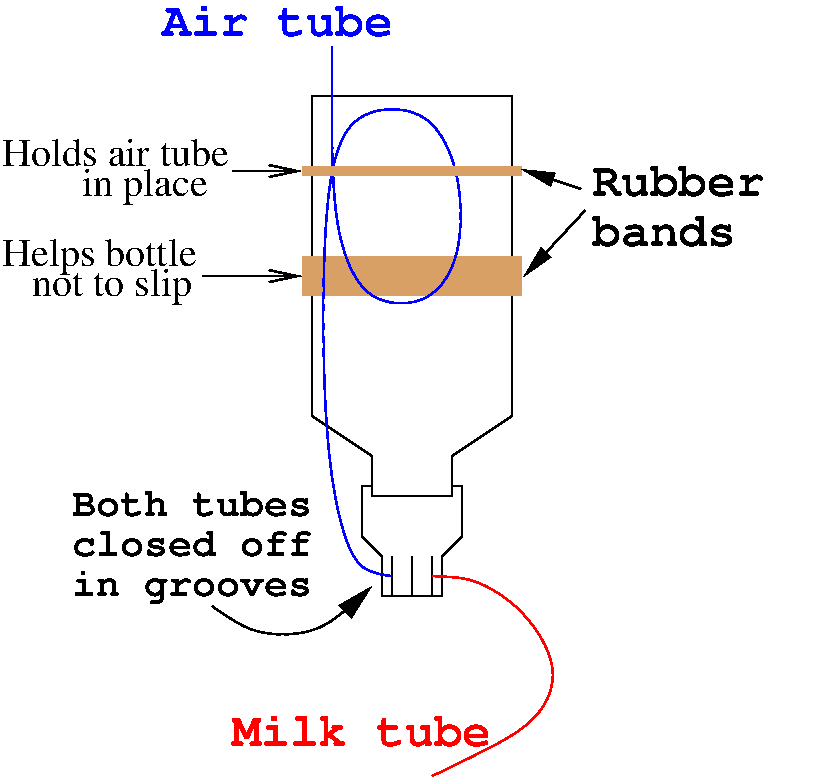
First some terminology. Of the two tubes, I call the one closest to the curved side of the bottle the air tube, and the one closest to the flat side of the bottle the milk tube .
Find a thin rubber band, and put it around the base of the SNS bottle and a wider rubber band and put that around the middle of the bottle. The thin rubber band is for holding the AIR tube in place (see below), and should not be so tight it constricts air flow. The wide rubber band helps keep the bottle from sliding when you rest the bottle on its side on an inclined surface.
Empty the tubes of any water by squeezing the empty bottle with the cap on. You can also suck on the tubes to clear them, if you don't have a cold, although it's true you can be producing cold germs before you have symptoms.
Fill SNS bottle with milk and screw cap on.
Keeping SNS bottle upright, take the AIR TUBE, close it off by pushing down into a groove in the cap and slip the loose end under the thin rubber band, making sure that the open end of the tube ends up near the base of the SNS bottle. This makes it harder for milk to dribble out. To avoid slack, you have to coil some of the tube under the rubber band.
Turn the bottle upside down and suck on the MILK TUBE until you taste the formula. Close the tube off. Put the bottle somewhere within arm's reach.
Latching on
Get baby ready. If you, the mother, are nursing in the sitting position, a nursing cushion, a towel under baby's head to catch spillage, and a footstool to raise your knees slightly above your hips, are helpful. If the available footstool is too high, just move it farther from your body. As usual, it's best if the baby's not screaming, and you've woken him up to feed when he's starting to make intermittent hunger sounds in his sleep, rather than when he's already become ravenous.
Grab SNS bottle and place on its side, flat side down, near baby's head on a sloping surface, such as the arm rest of the sofa, making sure that the milk is down at the cap end.
Take milk tube and see if you can get baby to latch on to both the breast and tube at the same time. Position tube end so that it is near nipple tip. Tube doesn't even have to be touching nipple or breast, baby's mouth closes and brings them together. The best length is when the tip of the tube is flush with or protrudes just beyond the nipple tip. If tube end protrudes too much beyond end of your nipple, the tube is more likely to slide off the side of your nipple and lie flat beside the nipple (no good). If tube end is shorter than nipple end, the tip of the tube can get buried in the flesh of your nipple and cut off flow.The best position is when the tube is at the roof of baby's mouth, rather than at the tongue-side. This is because tongue movement easily displaces the tube.
Alternatively, let baby latch on first, then thread the milk tube into his closed mouth. I do not recommend this method. I only used it in desperation in the early days. Once you and the baby get the hang of latching with the tube in place, you won't do it in this sequential order any more. However, I will describe the method. The best place to try is the corner of his mouth. Place finger of one hand against corner of mouth and pull up, exposing some of the nipple. With other hand, point tube end in direction of nipple tip, and give a quick push past the resistance of the baby's gums. This is often difficult. If your baby had teeth, would you be able to push the tube past the teeth? Probably not. The gums are not that different.
Once you think the baby has latched successfully, open milk tube by releasing from groove.
Getting the milk to keep flowing
If the milk tube is positioned correctly inside the baby's mouth, a vacuum forms inside the SNS bottle with each suck, and it gets harder and harder for baby to get milk. Now open the air tube. You will hear a bubbling sound, and you will see bubbles rising up inside the SNS bottle, as air enters the air tube and dissipates the vacuum.
If you don't hear or see bubbles, then you need to start over with positioning the tube. You will probably want to close off both tubes to minimize leakage before starting over.
How to know the milk is flowing
The milk is flowing if you feel milk on your nipple every time the baby sucks, if the milk is cold. (See exception to this rule in Advanced Tips below.)
The milk is flowing if you see bubbles forming rapidly and rising to the top every time the baby sucks. When the baby is pausing between sucks, the bubbles should stop or form slowly.
The milk is flowing if the air tube is free of milk, or the milk in the air tube is moving back into the SNS bottle. If the milk is moving so slowly you're not sure it's moving, it's NOT moving!
The milk is flowing if the baby is making swallowing motions (not to be confused with sucking).
Another test is to close the air tube, wait a few sucks, then reopen it to see if you get a burst of bubbles like you did in the previous section.
Sometimes, the milk will flow even though the tip isn't in the right place. This is when the tip is in the mouth, but not in the suction path, and the milk flows continuously with gravity. Usually, you don't want that. You only want the milk to flow when the baby sucks. Otherwise, the baby will gag. Signs that the milk is flowing from gravity is that bubbles will be forming rapidly even when the baby is pausing, and the milk will be leaking out of his mouth. The milk tube is not in the right place if the tube comes out of his mouth when you pull gently. In the right position, baby's gums will be clamped down on the tube, and there will be resistance to pulling the tube out.
However, if the baby's screaming and you just can't get the milk tube in the optimal position, to heck with it, let the milk flow with gravity and the baby take big gulps. Slow down the flow rate by lowering the SNS bottle so he's not gagging. You can either try repositioning the tube when he's fed a little and calmed down, or just let things be.
What to do if the flow seems to have stopped
Messing with the tube in place to reestablish flow, such as pushing the tube further in to baby's mouth, pulling out a little, or twisting, does not work, and it is best to start over by getting the baby to open mouth and latching again.
A clogged tube is never the reason for stopped flow. So never squeeze the SNS bottle. It just makes the baby gag, or makes the milk leak out of the seams of the cap, and doesn't correct the problem
If baby is falling asleep at the breast, a little bit of unwanted milk can wake him up and make him drink some more. The best way is to raise the bottle higher, making sure the air tube is open.
Sometimes, the air tube has bits of water in it from the last cleaning, and keep the air tube from working. Make sure air tube is clear of water.
Avoiding milk leaks
FIRST RULE--If you're new at this, at first sign of leak, turn SNS bottle upright. This is always the first thing you should do. This will limit amount of leak to whatever is in the tubes.
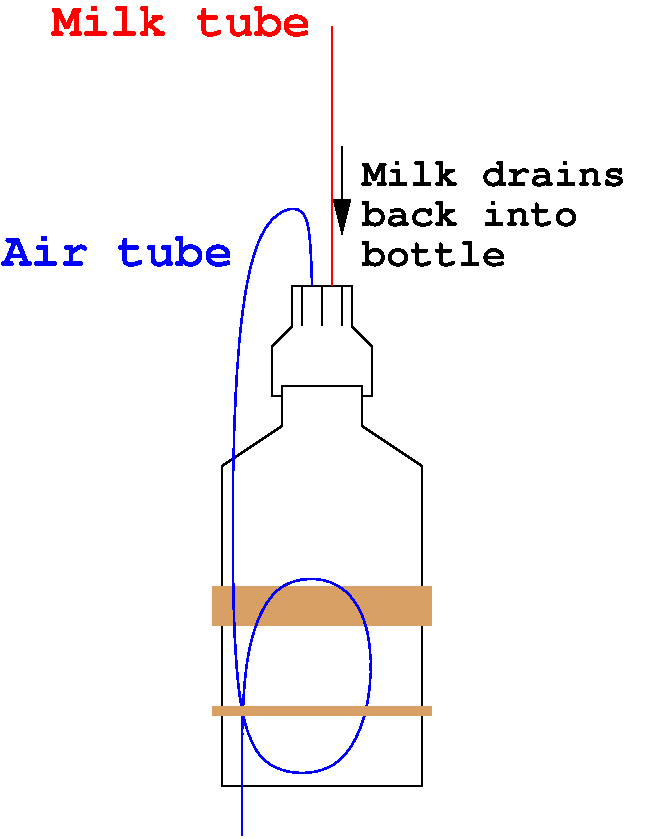
Next, hold end of milk tube straight up into the air, and wait for milk in the milk tube to drain mostly back into SNS bottle. As you get practice, you turn the SNS bottle upright and raise the milk tube at the same time.
Finally, close both tubes. Now you can do anything with the SNS bottle without having it leak.
Sometimes, overtightening the cap causes the tubing piece to be crooked with respect to the cap disk, and milk will leak from there. Make sure the cap end of the tubes are centered in the disk holes when tightening the cap.
Sometimes, milk will leak although both tubes are closed off, and the cap is tightened just right. This is because the refrigerator cold air inside the bottle warms up and expands. The milk has nowhere to go except out through the seams. To avoid, warm bottle to room temperature before feeding, or accept that some milk will leak until the baby latches, just keep a towel under the non-skid sheet under the bottle.
SNS Bottle height
SNS Bottle height works when the level of milk in the SNS bottle and tip of the milk tube are close. When the milk tube is optimally positioned in the suction path, SNS bottle height isn't too important. But when the milk is flowing by gravity, if the SNS bottle is too high relative to the tube tip, milk flows too quickly, and makes the baby choke. If the SNS bottle is too low, air enters the milk tube, plus milk tends to leak out of the air tube. In other words, the milk tube acts like the air tube and the air tube acts like the milk tube.
I tend to rest the SNS bottle on its side, on the cushion the baby's head is on so that the cap touches the baby's head.
Advanced tips
Once you get used to using the SNS, and learn how the air tube and milk tube work, try feeding the baby with the air tube closed off. If the tube end is in the suction path, the baby can still suck with enough force to draw milk from the SNS bottle against the vacuum for several minutes. Towards the end of feeding, or at times when the baby needs to satisfy his sucking urges rather than feed, the baby can prefer the slower flow. When you do this, you won't be seeing bubbles any more, so you'll have to rely on other clues that the milk is flowing. That's why it's better to wait to try this until after you've had lots of practice feeding baby with the air tube open.
If you're feeding with the air tube closed, you need to open the tube to release the vacuum every few minutes, and close again. Experiment with amount of time the air tube is open. Sometimes the baby will dislike the sudden rush of milk that occur with a full release of vacuum. Closing quickly will release the vacuum partially.
Once you're an expert feeding the baby both ways, with the air tube closed and open, you can go back and forth between the two. As another example, you won't need to coil the air tube under the rubber band right at the beginning. If you start off feeding with the air tube closed, you can do the coiling after the baby has fed a few minutes.
If the milk tube is positioned over baby's tongue or side of mouth, the milk tube can get sucked further and further into his mouth towards his throat, until he coughs. If this keeps happening, you'll have to keep hold of the milk tube while he feeds to prevent this. Sometimes you'll know the tube is migrating further into his mouth because you won't feel the cold milk any more, but you know from other signs that the milk is still flowing.
One reason you might want to feed some of the time with the air tube closed, is to encourage the baby to suck harder, if you are trying to establish your own milk flow.
Positioning of MILK and AIR tubes relative to the asymmetrical bottle shape: The bottle has a flat side and a triangular side. To minimize slipping of the bottle on whatever surface you've placed it on, you place the bottle flat side down. (It is also helpful to place a non-skid rubber sheet between the bottle and surface you want to lay it on.) You want the AIR tube to be the upper tube, and the MILK tube to be the lower tube coming out of the bottle cap, so that when milk levels get low, the baby does not suck air. Upper means on the triangular side, lower means flat side of bottle. This can be a problem if you have a dedicated AIR tube that ends up on the lower side of the bottle after you screw the cap on. To remedy this, loosen the cap a little, stick your finger into the indentation in the cap and turn the disk until the AIR tube is on the triangular side of the bottle at though your finger were a screwdriver, then taking care so that the disk doesn't turn relative to the bottle, tighten the outer cap.
SNS-ing in bed
Yes, you can SNS lying down in bed in the middle of the night! But don't try until you're already an expert SNS-ing sitting up.
You need a bright nightlight to provide some background light for the duration of the feeding, and also a good flashlight for initial tube positioning.
You also need to work out how you want to position your body, your baby, the SNS bottle and pillows. I lie on my right side, on top of an old flat pillow to raise my upper body so my right nipple is at the same height as my son's mouth. My right elbow is above my son's head, my right forearm under the second pillow for my head. The SNS bottle is on its side, also under the second pillow with the air tube on the upper flat side of the bottle. Alternatively, the SNS bottle can be on top of the pillow by your head, with a rubber non-skid sheet under it (the kind you use between area rugs and floor) to keep the bottle from sliding off of the pillow.
The hardest part is trying to get the milk tube into the mouth in the dark with just one free arm. One thing I do is try jabbing the milk tube end into the corner of the mouth and listen for the bubbling. If you are hard of hearing, and if you grasp the MILK tube in your hand, you can feel the cold milk flow with each suck. If the milk is not flowing, the milk in the tube warms up quickly.
Be prepared for some spillage. Lie on top of a towel. Try not to fall asleep, because inevitably, the tube pops out of the baby's mouth and you wake up an hour later with a cold wet patch below you.
Cleaning tips
There are 3 known ways to clean the SNS tubes. Hot soapy water, vinegar, and boiling. Since I'm paranoid about residual soap, and vinegar leaves a smell for a long time as well as not working that well on grease, I prefer to boil.
But a fourth way that gets rid of accumulated gunk is to thread a thick embroidery needle with several skeins of embroidery thread and gently work it through the tube to the cap. Squeeze and rub the tube against the needle and thread as you go. Make sure the thread is long enough so you can use it to pull the needle back out. Be careful as you advance the needle not to poke the needle through the tube wall. I ruined one tube that way.
Final Note
I wrote these notes because I couldn't get the SNS-ing to work for me using the instructions that came with the bottle. Trying to get the string around my head, long hair and glasses, trying to get the tape to stick to my breasts if it ever came off because wet milk keeps fresh tape from sticking, trying to cut the tape with the dull edge of the rinky-dink tape dispenser, trying to figure out if my son was drinking any milk, milk leaking everywhere, all with an increasingly frustrated crying baby on my lap, I cursed the manufacturer. When I heard the story of a mother who flung her SNS bottle at her husband who came home and asked how she was doing, I completely sympathized. I also want you to know that it's not only you that has to learn how to use the SNS, newborn babies also need to learn how to latch regardless of whether there's an SNS tube there or not. So it will be a learning process for both you and your sweet baby, and sooner or later, you'll both be pros. Don't lose heart! Good luck!